
Copiah County Court Records After a Jail Arrest
After a person is arrested and booked in Copiah County, the local court path depends on the charge level and the document that started the accusation. The official Justice Court page says criminal cases begin with affidavits filed by private citizens and agencies such as the Copiah County Sheriff's Department, Mississippi Highway Safety Patrol, municipal or campus law enforcement, state wildlife and transportation officers, the Mississippi Bureau of Narcotics, and constables. Misdemeanor affidavits are tried in Justice Court. Felony affidavits receive an initial appearance, with bond set by a justice court judge.
The jail and court records answer different questions. For custody, booking, and jail-docket information, use jail inmate records and the sheriff's office. For booking photographs, use the separate jail mugshots request route. Court records after a jail arrest focus on the case: the affidavit, complaint, information, indictment, bond order, hearing dates, charge amendments, dismissal, plea, sentence, or expunction order.
The Copiah County Justice Court source is especially important because it describes the local first-appearance route. If a felony defendant is not bonded out, counsel may request a preliminary hearing to decide whether probable cause exists to bind the matter over to the grand jury. Felony prosecution is handled by District Attorney Daniella M. Shorter's office, while filed Circuit Court records are routed through Circuit Clerk Derrick Cubit and Mississippi Electronic Courts where available.
How to Find Copiah County Court Records After an Arrest
Start with the stage of the case. A very recent arrest may still be at the sheriff or Justice Court stage, while an indicted felony belongs in Circuit Court records. Mississippi Electronic Courts, known as MEC, is the statewide electronic filing and case-management system, but online document access may require registration, a subscription, or paid page access. Courthouse terminal inspection may be the practical free route for some filed records.
The Copiah County Justice Court page is an official source for the first steps after arrest, including criminal affidavits, misdemeanor trials, felony initial appearances, bond setting, and preliminary hearings.
View the official Copiah County Justice Court page for the local criminal-affidavit and first-appearance description.
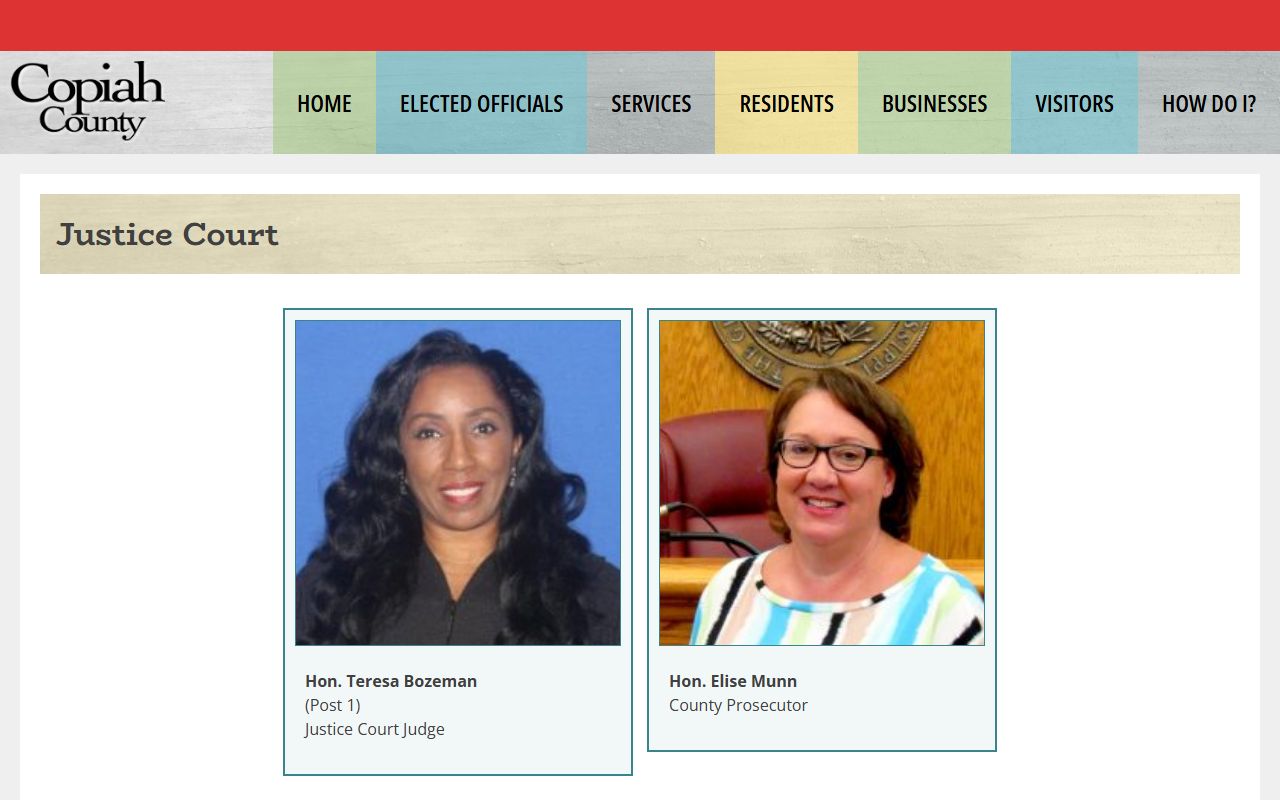
That source supports the local distinction between a jail arrest and the court record that follows it.
- Call the sheriff's office at (601) 892-2023 or (601) 894-3011 to confirm current custody, the arresting agency, and the booking charge.
- For misdemeanors, first appearances, traffic-criminal matters, and preliminary-hearing questions, contact Justice Court Clerk Mona Lisa Carr at 121 W. Frost Street, Hazlehurst, MS 39083, (601) 894-3218 or (601) 894-4403, fax (601) 894-6038, mcarr@copiahcountyms.gov.
- For felony filings, indictments, Circuit Court dockets, and records moved up from lower court, contact Circuit Clerk Derrick Cubit at 100 Caldwell Dr., Hazlehurst, MS 39083, P.O. Box 467, derrick@copiahcountyms.gov, (601) 894-1241.
- Search or request access through MEC when the case is in an MEC court, using the defendant name, case number, county, court, and date range when known.
- For prosecutor filing decisions in felony matters, contact the District Attorney's office at 272 West Gallatin Street, Hazlehurst, or P.O. Drawer 767, Hazlehurst, MS 39083, (601) 894-5040.
Mississippi Electronic Courts is the statewide portal for electronic court access where the court and case are included in MEC.
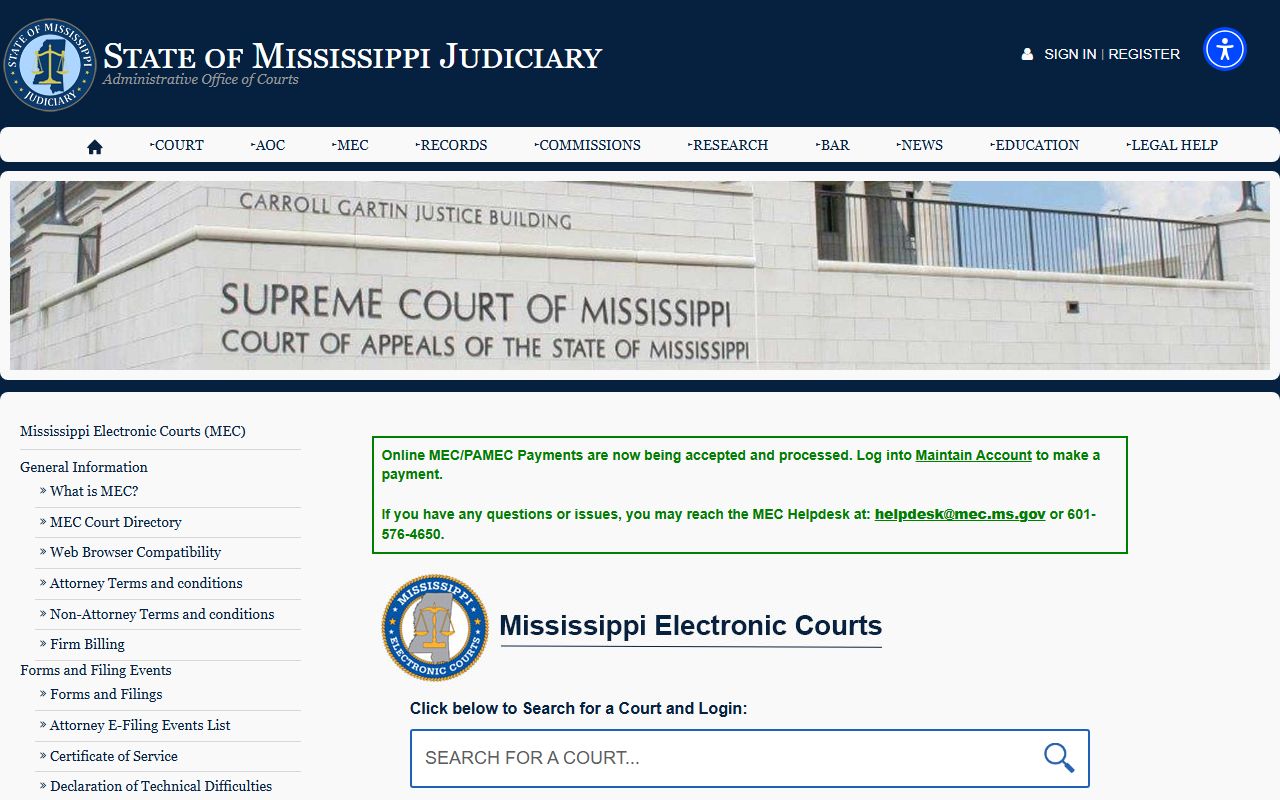
MEC should be treated as a court-record access channel, not as a live jail roster or booking-photo database.
| Search Field | How It Helps | Limit |
|---|---|---|
| MEC login or account | Allows online access when a case is available through MEC. | Registration, subscription, or per-page costs may apply. |
| Case number | Best match when found on a citation, indictment, clerk notice, or prior filing. | Not always known right after arrest. |
| Party or defendant name | Useful when the case number is unknown. | Exact spelling and name changes matter. |
| Court and county | Narrows results to Copiah County Circuit or Chancery where applicable. | Justice Court records may require direct clerk contact. |
| Date range | Helps separate a recent arrest from older cases with the same name. | Arrest date and file date may differ. |
How Charges Get Filed After an Arrest: Complaint, Information, and Indictment
Booking occurs at the jail, but a court charge appears through a charging document or sworn affidavit. In Copiah County, Justice Court criminal cases can begin with affidavits from citizens or listed law-enforcement agencies. Misdemeanors generally stay in Justice Court. Felony accusations may begin with an affidavit and initial appearance, then move toward District Attorney review, preliminary hearing when requested and available, grand jury action, indictment, and Circuit Court records.
| Complaint or Affidavit | Information | Indictment | |
|---|---|---|---|
| Filed By | Private citizen or law-enforcement agency through Justice Court procedure. | Prosecutor, when allowed by criminal procedure and case posture. | Grand jury after felony review. |
| Common For | Misdemeanors, initial accusations, and felony affidavits before higher-court action. | Some prosecutor-filed criminal matters. | Felony cases moving into Circuit Court. |
| Record Location | Justice Court clerk for local affidavits and misdemeanor matters. | Clerk handling the filed case. | Circuit Clerk and MEC where available. |
| Why It Matters | It may explain why the person was first brought before a judge. | It can replace or refine a preliminary accusation. | It is the formal grand-jury charging document. |
Charge Status in Court Records After Arrest
Charges can change after prosecutor review. A jail booking entry may list the cause of imprisonment or arrest charge, while the court record may later show a different count, a reduced charge, an added count, a dismissal, or a nolle prosequi. For that reason, compare the sheriff's booking information with the clerk's filed court record before relying on a charge label.
| Status | What It Means |
|---|---|
| Pending | The charge remains open and no final disposition has been entered. |
| Amended or Reduced | The filed charge was changed, corrected, lowered, or replaced by a different count. |
| Bound Over | A felony matter was sent forward for grand jury or higher-court review after probable-cause proceedings. |
| Dismissed | The charge ended without a conviction on that count. |
| Nolle Prosequi | The prosecutor formally declined to proceed on the charge. |
| Convicted | A plea or verdict resulted in conviction and sentencing or other disposition. |
Bond and Release After an Arrest
Mississippi Code section 99-5-11 authorizes justice court judges and other conservators of the peace to take recognizance or bond for eligible non-capital offenses. The same statute says financial bail conditions should not be set solely to detain a defendant and discusses recognizance consideration for indigent defendants. Locally, the Copiah County Justice Court page states that felony affidavits receive an initial appearance with bond set by the justice court judge.
Mississippi Code section 99-5-11 is the state-law reference for bond and recognizance in eligible cases.
| Bond Type | How It Works |
|---|---|
| Cash Bond | Money is posted to secure court appearance when the judge allows this form of release. |
| Surety Bond | A licensed surety or bail agent backs the bond, subject to court and jail acceptance rules. |
| Property Bond | Property may secure appearance when allowed by law and accepted under local procedures. |
| PR or Recognizance | The defendant is released on a promise to appear, when the judge authorizes it. |
| No-Bond Hold | Release is not available until a court or holding agency changes the custody status. |
No official Copiah County source located states bond desk hours, online bond payment, or jail bond payment methods. Confirm bond instructions with the sheriff's office or the court before sending money or relying on a payment method used for fines.
Warrants That Lead to an Arrest
No official Copiah County active-warrant search or most-wanted database was located on the county site. Use the sheriff's main numbers, (601) 892-2023 or (601) 894-3011, for warrant questions. If the warrant is tied to a missed court date, bench warrant, misdemeanor case, traffic-criminal matter, or preliminary hearing, Justice Court may be the better route. If it is tied to an indictment, Circuit Court order, or felony case, the Circuit Clerk and MEC are the more likely record channels.
Warrant records can create confusion because an arrest warrant, bench warrant, search warrant, and hold from another jurisdiction do different things. A jail booking may only show that a hold exists. The court record should identify the issuing court, case number, warrant type, and next hearing when those details are public.
Charges vs. Convictions
An arrest and a charge are not the same as a conviction. Court records after an arrest may show allegations that were later dismissed, reduced, amended, or not prosecuted. A conviction exists only after a guilty plea, verdict, or other qualifying disposition entered by the court.
| Charge | Conviction | |
|---|---|---|
| Stage | Accusation or filed count after arrest. | Final finding based on plea, verdict, or qualifying disposition. |
| Proof Level | May begin with probable cause or sworn affidavit. | Requires proof beyond a reasonable doubt or a valid guilty plea. |
| Where It Appears | Jail booking data, Justice Court affidavit, complaint, information, or indictment. | Court judgment, sentencing order, docket entry, or disposition record. |
| Practical Use | Shows what the person was accused of at that stage. | Shows the court's final result on that count. |
Sealed vs. Expunged Arrest Records
Public access can be limited by sealing, expunction, juvenile rules, an active investigation, or a court order. Mississippi's expunction statute, Mississippi Code section 99-19-71, allows eligible people to petition the proper court to expunge certain misdemeanor and felony conviction records. A clerk or sheriff generally needs the actual court order before changing how an official record is handled.
Mississippi Code section 99-19-71 is the expunction reference for eligible Mississippi records.
| Sealed | Expunged | |
|---|---|---|
| Visibility | Hidden or restricted from ordinary public inspection by rule or order. | Removed from public access as directed by the expunction order. |
| Record Holder | The court or agency may retain limited-access records. | The court order directs the required treatment of eligible records. |
| Eligibility | Depends on the record type, court order, juvenile status, or confidentiality law. | Depends on Mississippi expunction law and the court's order. |
| Requester Action | Ask the clerk whether public access is restricted and what order controls. | Provide the expunction order to the clerk, sheriff, or agency asked to update records. |
Background Check Considerations
Casual court-record lookup is different from a regulated background check. Court records can be incomplete, delayed, restricted, or later changed by a judge's order. Anyone making employment, tenant, credit, insurance, or similar decisions must use a lawful consumer-reporting process and should not treat a public case search as a complete background report.
Important: Not a consumer reporting agency; do not use public case lookup for FCRA-covered decisions.
Restricted Court Records After an Arrest in Copiah County
The Mississippi Public Records Act makes public records of Mississippi public bodies available for inspection unless a statutory exemption applies. It defines public records broadly, including papers, photographs, recordings, and other materials used or retained for public business. That broad rule does not mean every jail or court file is immediately open online. Juvenile matters, sealed cases, expunged records, court orders, protected victim information, and records tied to active investigations may be withheld or limited.
The Mississippi Ethics Commission Public Records Act page is the high-authority state reference for public-record access and enforcement. For a Copiah County arrest, ask for the specific record by name, date, court, and case number when possible. Direct jail-docket requests to the sheriff; direct filed criminal case records to the proper clerk; direct felony prosecution questions to the District Attorney when a prosecutor decision is the issue.